


- von EditorialTeam
Apple iPhone 16 Review Is It Still Worth Buying in 2026
- von EditorialTeam
The iPhone 16 is still a capable compact phone in 2026, with strong A18 performance, dependable cameras, useful physical controls and solid battery life. It is a sensible buy at a meaningful discount, especially for someone upgrading from an iPhone 13 or older. At close to newer-model pricing, however, its 60Hz display, USB 2 data speed and lack of a dedicated telephoto camera make it much less convincing. This review explains where it still feels current and where its age now shows.
|
Area |
What You Get |
Review Verdict |
|
Display |
6.1-inch OLED, 2556 x 1179, 60Hz |
Sharp and bright, but the refresh rate is dated |
|
Performance |
A18 chip, 6-core CPU, 5-core GPU |
Still fast enough for demanding apps and games |
|
Cameras |
48MP Fusion, 12MP Ultra Wide, 2x crop zoom |
Reliable photos and excellent video; no true telephoto |
|
Battery |
Up to 22 hours video playback |
Comfortable daily endurance for a compact iPhone |
|
Charging |
USB-C, up to 25W MagSafe and Qi2 |
Flexible, but USB-C data remains limited to USB 2 |
|
Best for |
Upgraders from iPhone 13 or older |
Buy on discount, not near newer-model pricing |
Pros: fast A18 chip, compact 170g body, strong main camera and video, macro photography, Action Button, Camera Control, Wi-Fi 7, and up to 25W MagSafe or Qi2 charging.
Cons: 60Hz display, no always-on display, no true optical telephoto lens, USB 2 transfer speed, and charging that is less aggressive than many Android competitors.
At 147.6 x 71.6 x 7.8 mm and 170g, the iPhone 16 is easier to hold and pocket than most current flagship phones. Its aluminum frame, Ceramic Shield front and color-infused glass back feel premium without the extra weight of a Pro Max. IP68 water and dust resistance adds reassurance, although water resistance is not permanent and does not make the phone suitable for deliberate underwater use.
The Action Button is more useful than the old mute switch because it can launch a shortcut, camera, flashlight, Focus mode or another chosen function. Camera Control is less essential. It can open the camera and adjust zoom, exposure and styles, but its position and pressure gestures can feel fiddly.
The compact size is useful on the go. If you regularly use navigation or shoot video away from an outlet, a slim USB-C power bank is easier to carry than a high-capacity pack.
The 6.1-inch Super Retina XDR OLED is sharp, color-accurate and readable outdoors, with Apple rating it for up to 2,000 nits peak outdoor brightness. The problem is motion. Scrolling and animations are limited to 60Hz, while many cheaper phones now use 90Hz or 120Hz panels. A buyer coming from an older standard iPhone may not mind; anyone accustomed to ProMotion will notice immediately.

The A18 remains the iPhone 16’s strongest reason for aging well. Its six-core CPU, five-core GPU and 16-core Neural Engine keep everyday use quick and provide enough headroom for gaming, photo processing and current Apple Intelligence features. The phone is not as fast as newer Pro models, but ordinary app launches, camera processing and multitasking rarely expose that difference.
The hardware also adds Wi-Fi 7, Bluetooth 5.3, the second-generation Ultra Wideband chip and satellite safety features. Long software support strengthens the value of a discounted iPhone 16, although the exact lifespan depends on Apple’s future iOS policy rather than a guaranteed number of years.
The 48MP Fusion main camera normally produces detailed 24MP images and can capture 48MP files when more resolution is useful. Its 2x option crops into the main sensor and gives cleaner results than ordinary digital zoom, but it is not a substitute for the 5x optical telephoto camera on the Pro models. Portrait processing, skin tones and stabilization remain dependable, particularly for users who want consistent results without editing every shot.
The 12MP Ultra Wide gains autofocus, enabling macro photography as well as wider scenes. Video is one of the phone’s best features: it records up to 4K Dolby Vision at 60 fps, supports Action mode and Cinematic mode, and includes Audio Mix for changing how voices and background sound are emphasized after recording. The missing piece is long-range photography; quality drops quickly once digital zoom moves beyond the useful 2x crop.
Apple rates the iPhone 16 for up to 22 hours of local video playback, 18 hours of streamed video and 80 hours of audio playback. Tom’s Guide recorded 13 hours 19 minutes in its 5G web-surfing test, compared with 13 hours 28 minutes for the Galaxy S24 and 13 hours 18 minutes for the Pixel 9. GSMArena’s mixed-use Battery Test 2.0 also gave the iPhone 16 a 15:42 Active Use Score, ahead of the iPhone 15 and Galaxy S24 in that test. These are strong results for a compact phone, although heavy gaming, navigation, weak cellular signal and high brightness can still require an evening top-up.
The RORRY CharmGo® D2 10000mAh Power Bank combines built-in USB-C and Lightning cables with an Apple Watch charging surface. Its keychain-style body is designed for carrying, so it suits commuters and short trips where a separate cable would be easy to forget.

At home, charging priorities change. Magnetic alignment is convenient on a desk or bedside table, while a shared station can reduce the number of adapters and loose cables needed for an iPhone, Apple Watch and earbuds. Wireless charging can create more heat than a cable, so keep the phone uncovered and allow airflow around the charger.
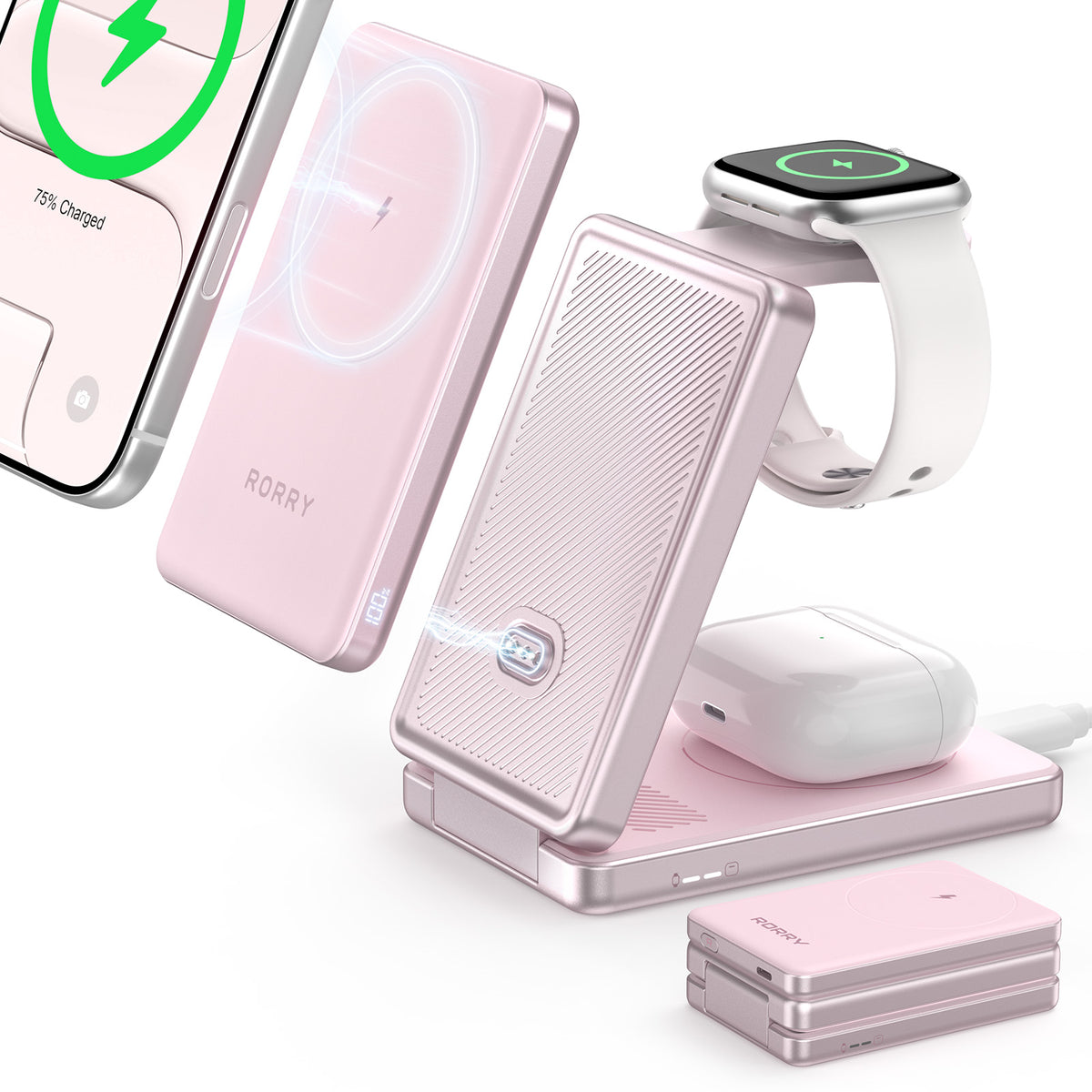
For that stationary setup, the RORRY AuraDock® M2 10000mAh 4-in-1 Charging Station provides 15W magnetic iPhone charging, Apple Watch and earbud charging, plus a detachable 10000mAh power bank with 30W USB-C input and output. It keeps several Apple devices on one charging station.

Wired fast charging can reach up to 50% in about 30 minutes with a 20W-or-higher adapter and USB-C cable. MagSafe and Qi2 can reach up to 25W when paired with the required higher-power adapter. The USB-C port also supports DisplayPort, but file transfer remains capped at USB 2 speeds of up to 480Mb/s.

The iPhone 16 sits in the middle of a clear three-generation progression. Compared with the iPhone 15, it adds the A18 chip, Apple Intelligence support, an Action Button, Camera Control, macro photography and faster MagSafe charging. Those are worthwhile upgrades for a new buyer, but they are not enough to make a one-year upgrade essential.
The iPhone 17 creates a more difficult comparison in 2026. Its 6.3-inch ProMotion display reaches up to 120Hz, Apple rates it for up to 30 hours of video playback, and wired charging can reach 50% in about 20 minutes with the required adapter. The iPhone 16 remains the lighter and potentially cheaper choice, but the 17 is the stronger long-term buy when the price gap is modest.
If you are also comparing newer options, the iPhone 17 vs iPhone 17 Pro differences explain what you gain by moving beyond the iPhone 16 generation.
The standard iPhone 16 is the better fit for buyers who value lower weight, a smaller body and strong everyday performance. The Pro is meaningfully better for people who notice display smoothness, regularly photograph distant subjects or move large ProRes and video files over USB-C. Its A18 Pro chip is faster, but the regular A18 already leaves little performance pressure in ordinary apps.
The trade-off is physical as well as financial: the iPhone 16 Pro weighs 199g compared with 170g for the iPhone 16. Both support up to 25W MagSafe charging, so the Pro premium is mainly buying display, camera and data-transfer capability rather than a major wireless-charging advantage.
The iPhone 16 remains the focus here, but its 2024 Android rivals expose its clearest trade-offs. Tom’s Guide recorded Geekbench 6 scores of 3,301 single-core and 8,033 multi-core for the iPhone 16, ahead of the Galaxy S24 and Pixel 9 in that test. The Galaxy S24 led the same review’s Wild Life Unlimited graphics result, however, and both Android phones provide 120Hz displays while the iPhone 16 remains at 60Hz.
Camera priorities are different rather than universally better. The Pixel 9 is especially competitive for computational still photography, while the Galaxy S24 adds a dedicated 3x telephoto camera that the iPhone 16 lacks. The iPhone answers with highly consistent video, strong app integration, Audio Mix and reliable color across common shooting conditions. Buyers already using Apple Watch, AirPods, iCloud or a Mac also gain more from the Apple ecosystem than a specification sheet shows.
Battery life is effectively a three-way tie in Tom’s Guide’s controlled web-surfing test. The iPhone 16 finished only nine minutes behind the Galaxy S24 and one minute ahead of the Pixel 9, then recovered slightly more charge after 30 minutes. Its weakness is not endurance so much as the lack of a 120Hz display at this class of phone.
The iPhone 16 succeeds because few parts of the experience feel slow or unreliable. Face ID is quick, the speakers are clear, cameras are consistent and the size is comfortable for one-handed use. Storage starts at 128GB, while 256GB is the more balanced choice for owners who keep phones for several years or record a lot of 4K video.
Its limitations are equally easy to understand. The display lacks high refresh rate, Camera Control is not essential, the dual-camera system cannot match a Pro model for zoom, and USB 2 transfer speed is frustrating when moving large video files by cable. None of these issues makes the phone poor; they determine whether its discounted price is genuinely good value.
Buy it if these priorities match yours:
· You want a compact iPhone with flagship-level everyday performance.
· You are upgrading from an iPhone 13 or older and want USB-C, better cameras and longer useful life.
· You care more about camera reliability and video than long optical zoom.
· The price is clearly below newer standard iPhone models.
Skip it if these limitations matter:
· You already use a 120Hz phone and do not want to return to 60Hz.
· You need a true telephoto camera, ProRes workflows or faster wired data transfer.
· You already own an iPhone 15 and the upgrade price is high.
· A newer model costs only slightly more.
Yes. The A18 chip remains fast for demanding apps and games, while the main camera, video quality and battery life still compete well with newer midrange and flagship phones. It is most attractive at a clear discount; paying close to iPhone 17 pricing is harder to justify because the iPhone 16 still has a 60Hz display.
No. The standard iPhone 16 uses a 60Hz OLED display, while the iPhone 16 Pro models offer adaptive ProMotion up to 120Hz. The difference is most noticeable when scrolling, gaming and moving between animations, especially if you already use a 90Hz or 120Hz phone.
The iPhone 16 offers a 2x view by cropping the center of its 48MP main sensor, which can produce useful results in good light. However, it does not have a separate telephoto camera, so distant subjects lose detail beyond 2x. Buyers who frequently photograph concerts, sports or wildlife will get better reach from an iPhone Pro model.
Apple says the iPhone 16 can reach about 50% in 30 minutes with a 20W-or-higher USB-C adapter. In Tom’s Guide testing with Apple’s 30W adapter, it reached 29% after 15 minutes and 57% after 30 minutes. MagSafe can deliver up to 25W with the required higher-power adapter, although heat and battery condition can reduce real charging speed.
For most iPhone 15 owners, no. The iPhone 16 adds the A18 chip, Apple Intelligence support, Camera Control, an Action Button, macro photography and better tested battery life, but its size, 60Hz display and general camera experience remain familiar. Upgrade only if several of those additions solve a specific need or the trade-in cost is unusually low.
The iPhone 16 remains a polished compact phone with strong performance, dependable cameras and useful charging flexibility. In 2026, it makes the most sense as a discounted upgrade from an iPhone 13 or older. Pay close attention to price: the 60Hz display, limited zoom and USB 2 port are acceptable compromises at the right discount, but difficult to defend when a newer iPhone is only slightly more expensive.


Share:
Do iPhones Have Lithium Batteries? Type, Life and Care