


- scritto da Fuzley
Which Power Bank Should I Choose: 5000 Ah or 10000 mAh?
- scritto da Fuzley
Choose 5,000mAh for a light emergency backup that is easy to carry every day. Choose 10,000mAh for long days, travel, heavier phone use, or more than one device. The right size depends on how much power you need before reaching an outlet and how much weight you are willing to carry.
Milliamp-hours, or mAh, describe how much charge a battery can store. A 10,000mAh power bank has about twice the rated capacity of a 5,000mAh model. That larger reserve can keep a phone running longer, but the number printed on the product is not the exact amount that reaches your phone.
Capacity also affects the way a charger fits into daily life. A 5,000mAh model is usually easier to carry in a pocket or small purse, while a 10,000mAh model gives you more freedom when outlets are hard to find. If portability is the priority, a compact keychain power bank can provide useful backup power without requiring a separate pouch of charging accessories.

Some energy is lost when a power bank converts its internal battery voltage into the voltage used to charge a phone. The charging circuit, cable, heat, and the phone itself all affect efficiency. Wireless charging normally loses more energy than a good wired connection because additional power is released as heat.
This is why a 5,000mAh power bank does not necessarily deliver one complete charge to every phone, and a 10,000mAh model does not guarantee exactly two. Phone battery size, battery health, temperature, signal strength, screen use, and charging method all change the final result. Treat capacity as a practical comparison, not a fixed charge-count promise.
For most buyers, the decision comes down to portability versus reserve power. The table below shows how the two sizes generally fit into everyday use.
|
Buying factor |
5,000mAh power bank |
10,000mAh power bank |
|
Best for |
Emergency top-ups, commuting, and short outings |
Long days, travel, and heavier use |
|
Portability |
Usually smaller and lighter |
Usually thicker or heavier |
|
Phone charging |
One substantial top-up; results vary |
More than one top-up for many phones; results vary |
|
Multiple devices |
Better for occasional accessory charging |
Better for a phone plus a watch or earbuds |
|
Power bank recharge time |
Usually shorter at the same input wattage |
Usually longer at the same input wattage |
|
Main compromise |
Less reserve power |
More weight and bag space |
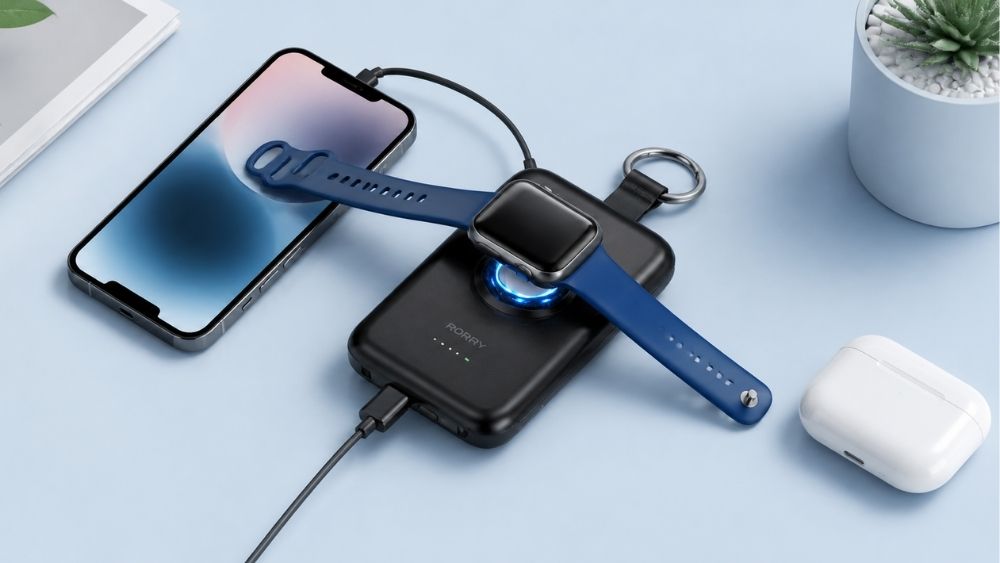
The difference is easier to understand when you compare complete charging designs instead of capacity alone. RORRY portable chargers are available in different capacities and configurations for iPhone, Apple Watch, AirPods, and USB-C devices, so buyers can match both the battery size and built-in features to their routine.
Capacity and speed measure different things. The mAh rating tells you how much charge a power bank stores, while wattage tells you how quickly it can deliver power under compatible conditions. A 5,000mAh charger with 20W output can charge a phone faster than a 10,000mAh charger limited to a lower output.
Check that the power bank, cable, and phone all support the same fast-charging standard. Charging will also slow as the phone approaches full capacity to help manage heat and battery stress. A larger capacity may keep you powered for longer, but it does not automatically make each charging session faster.
A 5,000mAh power bank is usually enough when you begin the day with a charged phone and need extra power to reach the evening. Its main advantage is not maximum endurance; it is being small enough to carry without thinking about it.
For a regular commute, 5,000mAh can provide a useful safety margin for music, messages, maps, and calls. It is a practical option when outlets are available at home or work but not during the journey between them.

If your day mainly includes messaging, calls, occasional browsing, and music, you may not use the extra capacity of a larger charger. A smaller model can cover a delayed train, unexpected errands, or an evening plan without adding unnecessary weight.
A 5,000mAh charger also suits dinners, concerts, weddings, sporting events, and short sightseeing trips. These situations often involve extra photos, video, or navigation, but they do not always require enough energy for several complete phone charges.
The limitation is that modern phones vary widely in battery size. A large phone, an older battery, cold or hot weather, and heavy screen use can reduce the percentage gained. Choose 5,000mAh as a convenient extension of your phone battery rather than a multi-day power source.
A 10,000mAh power bank is the safer choice when you regularly finish the day with very little battery or cannot predict when an outlet will be available. It offers more flexibility without moving into the weight of a much larger 20,000mAh model.
Navigation, video recording, gaming, video calls, mobile data, and hotspot use can drain a phone quickly. A larger reserve lets you keep using these features instead of lowering screen brightness, turning off connectivity, or saving the remaining battery for emergencies.
Ten thousand milliamp-hours is better suited to flights, road trips, conferences, theme parks, festivals, and full days of sightseeing. Both 5,000mAh and 10,000mAh models are normally far below the FAA's 100Wh threshold, but power banks must stay in carry-on baggage rather than checked baggage. Airlines may apply additional restrictions, so check the current policy before flying.
If you carry an iPhone, Apple Watch, and AirPods, a 10,000mAh power bank gives you more room to divide power between them. Charge-count estimates can still vary, so understanding what mAh means on a power bank will help you compare rated capacity with the energy that devices actually receive.
A 10,000mAh model is not automatically the best everyday choice. It normally weighs more, occupies more space, and takes longer to refill than a comparable 5,000mAh version. If the added size makes you leave it at home, the extra capacity has little value.

The best power bank is not defined by mAh alone. Two models with the same capacity can provide very different charging experiences depending on their size, output, ports, and built-in accessories.
Look for an output that matches the devices you plan to charge. USB-C Power Delivery can provide faster wired charging for compatible iPhones and other USB-C devices, but the phone will only draw the power it supports. Higher output is especially useful when you need a meaningful top-up during a short break.
Check the actual measurements instead of assuming every 5,000mAh or 10,000mAh model has the same shape. Slim magnetic chargers, cable-equipped models, and batteries with displays or stands may feel very different in a pocket. Think about where you will carry the charger and whether you plan to use the phone while it is attached.
Built-in cables reduce the number of accessories you need to remember and can make charging easier while walking or traveling. For readers who want a larger reserve in one organized design, the RORRY CharmGo D2-10000mAh Keychain Power Bank 20W combines built-in USB-C and iPhone cables with Apple Watch charging and a keychain ring.
The D2 10,000mAh is listed at 0.44 pounds, so it is better suited to a purse, backpack, or travel bag than someone seeking the lightest pocket backup. The 5,000mAh version is listed at 125g and is the more convenient option when daily portability matters more than maximum reserve.

A power bank also needs to be recharged. Larger batteries generally take longer to fill when input wattage is the same. Check the supported input power and use a compatible wall charger so the power bank is ready before the next trip. A battery that regularly sits empty will not help when you leave home.
Use this quick decision process:
1. Check how much phone battery normally remains when you reach home.
2. Identify your highest-use days, including travel, navigation, photography, video, gaming, and hotspot use.
3. Count the devices you may need to charge before reaching an outlet.
4. Decide whether pocket comfort or extra reserve matters more.
5. Compare wattage, dimensions, weight, connectors, cables, and recharge time.
Choose 5,000mAh if you mainly need a dependable safety net and want the easiest size to carry. Choose 10,000mAh if you frequently need more than a top-up, spend long periods away from outlets, or charge several small devices. Buying more capacity than you use only adds weight; buying too little can leave you without enough power when plans change.
It is often enough for a substantial top-up and may approach one full charge for some iPhones. The result depends on the iPhone model, battery health, temperature, charging efficiency, and whether the phone is being used while charging.
Many modern phones can receive more than one full charge from a 10,000mAh power bank, but there is no universal number. Larger phone batteries, conversion losses, wireless charging, and screen-on use reduce the final charge count.
No. Capacity is measured in mAh, while charging speed is measured in watts. Compare the power bank's output and the fast-charging standards supported by your phone and cable.
It is normally below the FAA's 100Wh threshold for personal power banks. Power banks must remain in carry-on baggage and should be protected from damage or short circuits. Always confirm the airline's current rules before departure.
No. A larger model provides more reserve but also adds size, weight, and recharge time. The best option is the smallest capacity that reliably covers your normal needs and occasional heavier-use days.
A 5,000mAh power bank is best for light daily carry, short outings, and emergency top-ups. A 10,000mAh model is better for travel, heavy phone use, long days, and multiple devices. Compare usable capacity, wattage, size, weight, connectors, and access to outlets so the charger fits your routine and is easy enough to carry when you need it.


Share:
Best Portable Chargers for iPhone 2026
Top 10 Creative and Practical Corporate Gifts