


- scritto da kehuiyi
6 Types of Phone Chargers: How to Choose the Best
- scritto da kehuiyi
Most people own more than one charger but have never thought about why. The type of charger you use affects how fast your phone charges, how long your battery lasts, and how practical your setup is at home, at work, or on the go. Here are the six main types, what to look for when buying, and how to pick the right one for your situation.
Phone chargers fall into six categories based on where and how they are used. Most people end up using two or three of them regularly.
Wall chargers are the most common type — a compact adapter that plugs into a wall outlet and charges your phone via cable. They are the fastest and most reliable way to charge at home or in the office.
USB-A vs USB-C. USB-A is the older rectangular port found on legacy chargers, typically topping out at around 12W. USB-C supports USB Power Delivery, enabling 20W to 65W for phones and up to 140W for laptops. For any modern smartphone, a USB-C PD wall charger will always outperform a USB-A adapter.
GaN wall chargers. GaN (Gallium Nitride) is a newer semiconductor material that allows chargers to run cooler and more efficiently than traditional silicon designs. A 65W GaN charger can be roughly the size of an old 20W adapter. If desk space or bag space matters, GaN is worth the slight price premium.
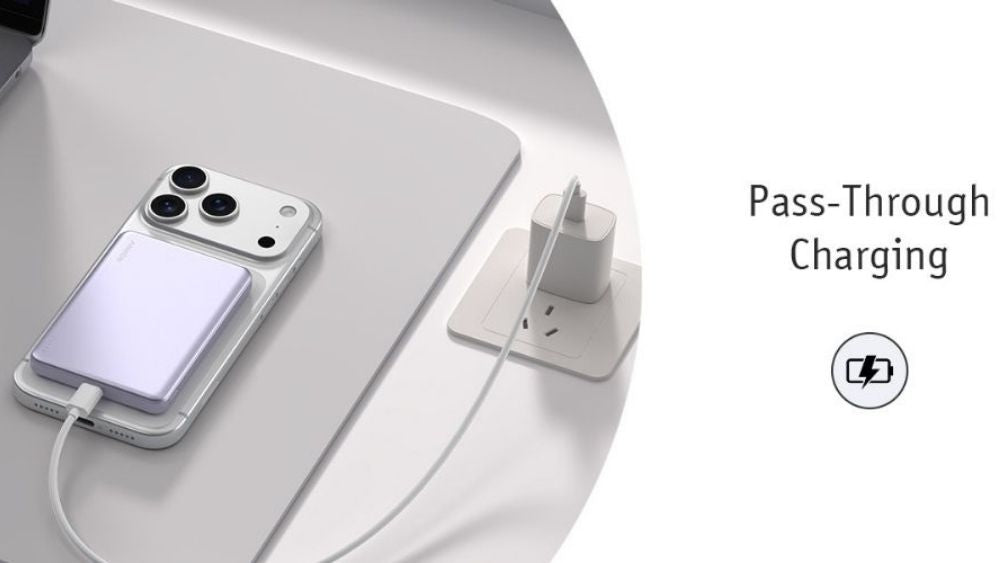
Plug-in power banks. Some manufacturers now make a hybrid option — a Plug In Power Bank that functions as both a wall charger and a portable battery. You plug it directly into an outlet to charge devices, and when you unplug it, it works as a standard power bank. Useful for travel when you want fewer items to carry.

Wireless chargers use induction to charge your phone through its back panel without a cable connection. They are more convenient for bedside and desk use, but generally slower than wired charging.
Standard Qi. Qi is the universal wireless charging standard supported by most modern smartphones. It delivers 5W to 15W — adequate for overnight charging but slow for a quick top-up. The main limitation is alignment: place the phone off-centre and charging efficiency drops.
MagSafe and Qi2. Both use a ring of magnets to automatically snap the phone into the correct position, solving the Qi alignment problem and enabling consistent 15W charging. MagSafe is Apple-only (iPhone 12 and later). Qi2 is a universal magnetic wireless charging standard developed by the Wireless Power Consortium, available to any manufacturer and supported by compatible Android flagships as well.
Portable chargers let you charge your phone without access to a wall outlet — essential for travel, commuting, and outdoor use. When choosing a portable charger, two specs matter most: output wattage and capacity.
Wired vs wireless power banks. Standard power banks charge via USB-C cable. Wireless power banks add a Qi or Qi2/MagSafe surface so you can charge by magnetically snapping the phone to the back of the bank.
Capacity (mAh). 5,000mAh provides roughly one full phone charge. 10,000mAh covers two to three charges and is the most practical size for everyday carry. 20,000mAh or more is suited for multi-day trips or charging multiple devices.

Car chargers plug into your vehicle's 12V socket and provide USB charging while driving. They are useful for navigation-heavy trips, long drives, and daily commuters who regularly drain their battery using GPS.
Look for at least one USB-C PD port at 20W or higher. USB-A car chargers work but are significantly slower. Dual-port models let you charge a phone and a passenger's device at the same time.
Multi-port chargers combine several USB-C and USB-A ports into one wall adapter, allowing multiple devices to charge from a single plug. A GaN multi-port charger can simultaneously charge a phone, tablet, and laptop from a unit smaller than a traditional laptop brick.
The key detail to check is per-port power distribution. A charger rated at 65W total may split to 45W and 20W when both ports are active. Always check the spec sheet, not just the total wattage figure.
Desktop charging stations sit on a surface and offer multiple charging options in one unit — typically a mix of USB-C ports, wireless charging pads, and sometimes a dedicated Apple Watch puck. Unlike multi-port chargers, they are designed to stay in one place rather than travel.
They suit households or offices with several devices to charge overnight, or anyone who wants a single organized station for phone, earbuds, and smartwatch. Most desktop stations include a dedicated Apple Watch puck alongside the phone charging surface, which standard Qi or Qi2 pads cannot provide.

Yes, and it is one of the most overlooked factors. The cable is part of the same circuit — an under-rated cable will cap charging speed regardless of how powerful the adapter is.
USB-C cables vary widely in their power ratings. A cable rated for 60W paired with a 100W charger limits the output to 60W. Cables labelled "USB-C" without a wattage rating are often basic data cables that cannot handle fast charging. For fast charging, always use a cable explicitly rated for the wattage you need, from a manufacturer that specifies the rating clearly.
Match the charger's output to your device's maximum charging rate. 20W is the baseline for modern iPhones. Android flagships typically support 25W to 45W. Laptop charging via USB-C PD requires 65W or higher. A lower-wattage charger will not damage the device but will charge it more slowly. The same principle applies to power banks — what mAh means on a power bank is worth understanding before comparing capacity specs, since some manufacturers list input capacity rather than usable output.
USB-C with Power Delivery is the current standard for fast charging across phones, tablets, and laptops. USB-A ports are useful for older devices and accessories, but cannot deliver fast charging speeds. For any new charger purchase, prioritize USB-C PD.
A reliable charger should include basic protections against overvoltage, overcurrent, and overheating. For wireless models, Qi or Qi2 certification from the Wireless Power Consortium is a useful sign that the product has passed independent safety testing. Well-known brands such as Anker and RORRY usually provide clearer safety specifications, while uncertified chargers from unknown brands may lack these protections.
GaN chargers produce less heat and allow higher output in a smaller form factor than traditional silicon chargers. If portability or compactness matters, a GaN charger offers better value than a traditional adapter at the same wattage.
|
Situation |
Best Type |
What to Look For |
|
Home or office |
Wall charger |
USB-C PD, 20W+ for phones, GaN for compactness |
|
Travel or commuting |
Portable charger |
10,000mAh for day trips, 20,000mAh+ for multi-day |
|
Desk or nightstand |
Wireless charger |
Qi2 or MagSafe for iPhone, standard Qi for Android |
|
In the car |
Car charger |
USB-C PD, 20W+, dual-port for passengers |
|
Multiple devices |
Multi-port charger |
Check per-port wattage when all ports are active |
|
Phone + Watch + Earbuds |
Desktop charging station |
3-in-1 with dedicated Apple Watch puck |
Yes. USB-C is a universal connector, but charging speed depends on both the charger and the cable. Your phone charges at the maximum speed both components support — whichever is lower becomes the limit.
Generally yes. Standard Qi delivers 5W to 10W. MagSafe and Qi2 reach 15W. A wired USB-C PD charger at 20W or higher will always be faster than any current wireless standard.
No. Phones regulate how much power they draw. A 65W charger connected to a phone that supports 25W will only deliver 25W — the excess capacity is unused.
10,000mAh covers most day-trip needs with one to two full phone charges. 20,000mAh or more is better for multi-day travel or if you need to charge a tablet as well.
Each type of charger is suited to a different situation. Wall chargers for speed at home, power banks for portability, wireless chargers for desk and bedside convenience, car chargers for the road, and multi-port or desktop stations for managing several devices at once. The right choice depends on where you spend most of your time and what you need to keep charged.
Rorry's portable chargers and wireless charging accessories cover home, travel, and everyday carry — built with regulated output and Qi2 compatibility so your devices charge reliably wherever you are.


Share:
What Is Qi2 Wireless Charging? Qi vs Qi2 vs MagSafe
Does Apple Watch Come with a Charger in 2026? Charging Guide