


- von EditorialTeam
Is It Safe to Charge Your Phone Overnight?
- von EditorialTeam
Yes. A healthy modern phone can normally remain connected to a compatible charger overnight because its charging system stops the battery from being overfilled. The habits that matter are controlling heat, using undamaged equipment, keeping the phone uncovered, and enabling its battery charging optimization.
Overnight charging is generally safe when the phone, cable, adapter, and outlet are in good condition. Modern smartphones control how much power reaches the battery and reduce or stop active charging when it is full. You do not need to wake up and unplug the phone the moment it reaches 100%.
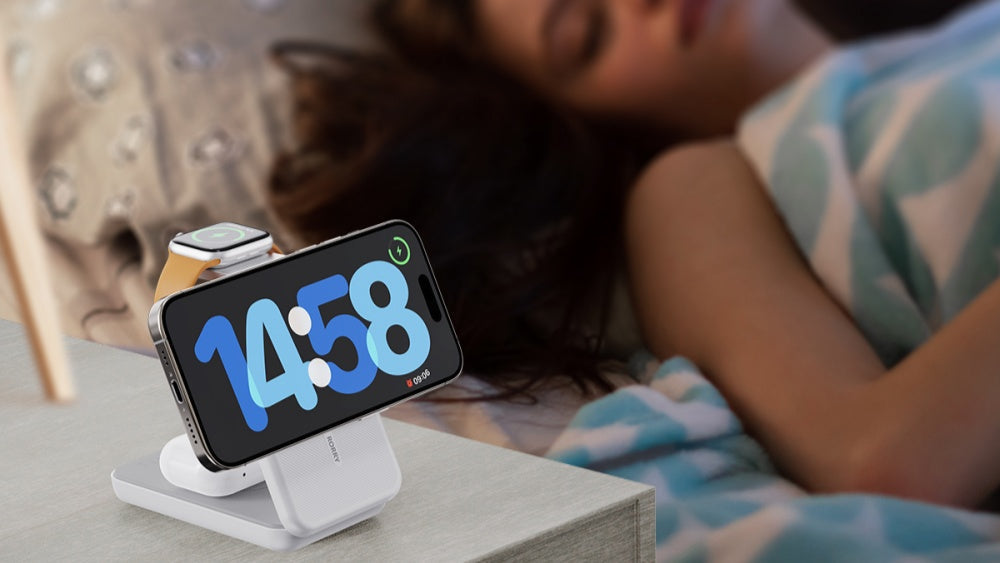
The safest setup is simple: place the phone on a hard nightstand with open airflow and use compatible charging equipment. A well-aligned 3 in 1 charging station can also keep a phone, watch, and earbuds in assigned charging positions instead of leaving several loose cables around the bed.

Safe does not mean that every setup is equally good for battery health. A phone trapped under bedding, exposed to a hot room, connected to a damaged cable, or charged with an unsuitable adapter can overheat. The length of the session is less important than temperature, equipment condition, and how long the battery remains completely full.
A modern phone does not continue forcing full charging current into a full battery. Its battery management system monitors voltage, current, charge level, and temperature. As the battery fills, charging slows; at full charge, the phone stops active charging and runs from the connected power source as needed.
The battery level can later fall slightly because the phone still handles background tasks. Charging may briefly resume to maintain the selected level. This behavior is controlled and is not the same as continuously overcharging the battery, but spending many hours at a high state of charge can still contribute to gradual chemical aging.
Phones also protect themselves from temperature extremes. An iPhone may slow or pause charging until it returns to a suitable temperature, and Android phones use similar thermal controls. If the phone displays a temperature warning or charging-on-hold message, let the protection work instead of repeatedly reconnecting the charger.

One overnight charge will not noticeably damage a healthy battery. Long-term wear comes from repeated charge cycles, time spent at high charge levels, and especially heat. All rechargeable phone batteries lose capacity as they chemically age, regardless of whether they are charged during the day or at night.
A full battery sits at a higher voltage than a partly charged one. Keeping it full for long periods can create more chemical stress, which is why phone makers now provide charge limits and adaptive charging. These features do not imply that reaching 100% is dangerous; they reduce unnecessary time at 100% when maximum daily range is not needed.
Charging speed can affect temperature, but wattage alone does not decide battery lifespan. Our comparison of fast and slow charging explains why heat and charging conditions matter more than treating every fast charger as harmful. Overnight, speed offers little benefit once the phone will remain connected for several hours.
Beds, pillows, blankets, sofas, and thick fabric trap heat around both the phone and adapter. A charging device should never be covered or placed where airflow is blocked. Apple advises avoiding use or charging above an ambient temperature of 95°F (35°C), as high heat can permanently shorten battery lifespan.
A frayed cable, loose connector, cracked adapter, bent plug, damaged outlet, or swollen battery should not be left charging unattended. Poor connections can create heat, and damaged lithium-ion cells can become unstable. Replace questionable accessories and arrange professional service for a swollen or physically damaged phone.
Choose equipment designed for the device and inspect it regularly. RORRY charging solutions include wired, magnetic, portable, and multi-device options, but any charger should be disconnected if its housing, cable, or plug shows physical damage or becomes unusually hot.
Do not connect a wet phone, cable, or charging port. With wireless charging, remove coins, cards, keys, and other metal objects from the charging area. Center the phone correctly and use a compatible case; poor alignment or an interfering object can reduce efficiency and increase heat.
Use a stable, hard, open surface such as a nightstand or desk. Keep the phone, charger, and cable away from bedding, curtains, paper, direct sunlight, heaters, and liquids. The adapter should fit firmly in the outlet without leaning, sparking, or becoming excessively hot.
On iPhone, Optimized Battery Charging can pause near 80% and finish closer to the time you normally unplug. Recent iPhones also offer adjustable charge limits. Pixel phones provide Adaptive Charging or an 80% limit, while supported Samsung phones offer Battery Protection and sleep-time charging controls. Names and menu locations vary by model and software version.
Leave the optimization enabled for a regular overnight routine. Adaptive features need time to learn when you usually disconnect the phone, so they may not activate immediately or while traveling. If you need maximum range the next morning, allowing a full charge is reasonable.

Both can be safe. Wired charging is usually more energy-efficient and often produces less heat, while wireless charging is convenient and reduces repeated cable handling. For overnight use, choose the method that stays cool, holds a stable connection, and works with the phone's charging optimization.
Wireless charging depends more heavily on alignment. A compatible magnetic system can keep the coils centered, but the phone should still remain uncovered with nothing trapped between it and the charger. If the device becomes unusually warm, remove the case, check alignment, or switch to a wired connection.
For an organized Apple bedside setup, the RORRY M3 10000mAh Charging Station provides separate charging positions for a compatible iPhone, Apple Watch, and AirPods case. Its foldable 3-in-1 design reduces cable clutter and includes protection against overheating, overcharging, and short circuits. Use an adapter above 20W when charging the station while it powers multiple devices, as specified on the product page.

A healthy modern phone prevents the battery from being continuously charged beyond full capacity. It may briefly maintain the selected charge level, but this is controlled by the battery management system. Heat, damaged hardware, and unsuitable accessories are more important risks than literal overcharging.
An 80% limit can reduce time at high voltage and may help long-term battery health, but it also provides less daily runtime. Charging to 100% is appropriate when you need the range. Use the phone's charge limit or adaptive feature instead of following a percentage that does not fit your day.
The phone should be on a separate hard surface with airflow, not in the bed, under a pillow, or pressed against your body. Keep the cable positioned so it cannot wrap around you or be pulled during sleep, especially where children or pets can reach it.
Yes, if the charger and cable are compatible and undamaged. The phone controls the power it accepts and reduces charging speed as the battery fills. Because overnight sessions provide plenty of time, a cooler lower-power method can also be sufficient when fast charging is unnecessary.
No. Turning the phone off can reduce background power use, but it is not required for safe charging. Locking the screen, allowing charging optimization to work, and placing the device in a cool, ventilated location are more practical steps.
Charging a healthy modern phone overnight is generally safe. The phone prevents conventional overcharging, but battery health and household safety still depend on temperature, ventilation, equipment condition, and charging settings. Use compatible accessories, keep the device on a hard uncovered surface, enable optimized charging, and stop using any phone or charger that is wet, swollen, damaged, or unusually hot.


Share:
Is It Safe to Use Your Phone While It Is Charging?