


- par kehuiyi
What Is the Best Power Bank for Travel? (Flight-Approved)
- par kehuiyi
The best travel power bank isn't just about capacity — it's about what clears security, charges fast enough between connections, and doesn't add unnecessary weight to your bag. This guide covers what to look for, the airline rules you need to know, and four flight-approved options for different travel styles.
More isn't always better — airlines cap what you can carry, and heavier power banks add weight. For a short trip with one phone, 10,000mAh is enough. For multi-day travel or multiple devices, 20,000–25,000mAh gives you real range. When traveling, it is very important to consider what size power bank you need.
This determines how fast your devices charge. 18W–20W is standard for phones; 30W+ handles newer iPhones and iPads properly; 65W is needed for laptops. A power bank with too low output will trickle-charge your devices.
At a minimum, one USB-C PD port. If you travel with multiple devices, look for two or more outputs — including one capable of high-wattage charging.
Carrying fewer accessories is the goal. A power bank with a built-in USB-C cable or foldable wall plug means one less thing to pack and one less thing to lose.
Look for UL, CE, or FCC certification. Uncertified power banks can be flagged at security or confiscated. Certified power banks also protect your devices from voltage spikes — important when you're relying on them abroad.
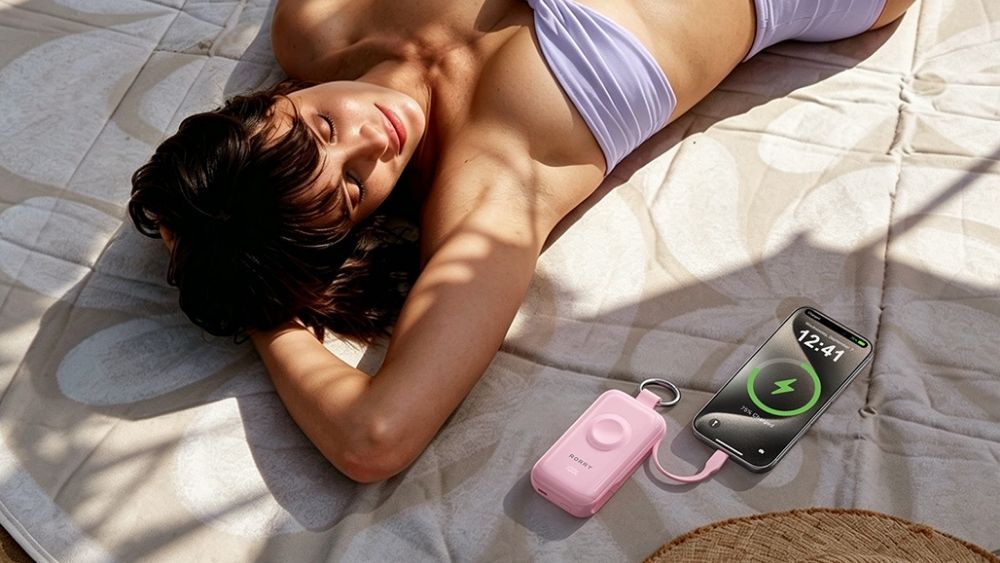
When you're out and about, the weight of your power bank is also very important. If it's too heavy or inconvenient to charge, it can make your trip very tiring. A compact design—especially a keychain style—is easy to put in your pocket or hang on your bag.

Power banks must go in carry-on luggage — never checked bags. This applies on virtually every airline worldwide. The limit is based on watt-hours (Wh), not mAh.
|
Capacity (mAh) |
Approx. Wh |
Airline Policy |
|
Up to ~27,000mAh |
Up to 100Wh |
Allowed without approval on most airlines |
|
~27,000–43,000mAh |
100–160Wh |
Allowed on some airlines with prior approval |
|
Above ~43,000mAh |
Above 160Wh |
Not permitted in carry-on or checked bags |
To convert: Wh = (mAh × voltage) ÷ 1000. Most power banks run at 3.7V, so a 25,000mAh bank is roughly 92.5Wh — within the standard limit.
Best for: Light travelers and Apple Watch users
The D4 is the most compact option here — a keychain-style design that clips to a bag or sits in a jacket pocket without you noticing. Despite its small size, it outputs 45W, which charges an iPhone 17 to 70% in 30 minutes. The standout feature is the built-in magnetic Apple Watch charger, so Apple ecosystem users can leave the Watch puck at home entirely. Pass-through charging lets you top up the power bank and your phone simultaneously.

Best for: Travelers who want zero extra accessories
The CB4 has a built-in USB-C cable and a foldable wall plug, which means you can charge your phone directly from it without any cables, and recharge the power bank itself by plugging it straight into a wall outlet. No adapter needed, no cables to pack. It also includes Apple Watch charging. At 40W, it gets an iPhone to 50% in 20 minutes. Customers consistently highlight it as one of the most practical all-in-one designs they've used for travel.

Best for: Multi-day trips and multi-device users
The D2 doubles the capacity of the D4 while keeping a portable keychain form factor. Two built-in cables (Lightning and USB-C), Apple Watch charging, a battery percentage display, and 30W PD output cover the full Apple ecosystem without carrying additional accessories. The 20,000mAh capacity translates to roughly 4–5 full phone charges — enough for a long weekend trip without worrying about finding an outlet. Flight-approved.

Best for: Business travelers and laptop users
The H3 is the serious option — 25,000mAh with 65W PD output, enough to charge a MacBook Air to full and still have power left for your phone. A retractable built-in cable (tested for 20,000+ retractions), HD digital display showing real-time wattage, and three simultaneous outputs make it the most capable option here. At roughly 92.5Wh, it stays inside the standard airline 100Wh limit. Reviewers specifically call it out as a strong pick for laptop charging while traveling.
→ RORRY H3

|
Model |
Capacity |
Max Output |
Built-in Cable |
Apple Watch |
Best For |
|
CharmGo D4 |
10,000mAh |
45W |
Yes |
Yes |
Light travel, Apple users |
|
Flow CB4 |
10,000mAh |
40W |
Yes + Wall plug |
Yes |
Zero-cable travel |
|
CharmGo D2 |
20,000mAh |
30W |
Yes |
Yes |
Multi-day, multi-device |
|
H3 |
25,000mAh |
65W |
Yes (retractable) |
No |
Laptops, business travel |
An obvious one, but easy to forget. Plug it in the night before, not the morning of.
High-wattage ports are typically labeled or marked — plugging a phone into a 65W port when the power bank has a 30W port available wastes the power bank's faster output on a device that doesn't need it.
USB ports on a laptop deliver a fraction of wall-charger speed. If you're recharging your power bank, use a wall outlet or the built-in plug (on the CB4).
Not just a rule — lithium batteries in a pressurized cargo hold can be a safety risk. Keep it with you.
Airport lounges, gate areas, and hotel rooms all have outlets. Plugging in for 20–30 minutes whenever you have the chance means you arrive at your destination with more than you left with.
If you're not using the power bank for a few days mid-trip, storing it partially charged reduces chemical stress on the cells and keeps it in better condition for when you need it.
The right travel power bank depends on how long you're going, how many devices you carry, and whether you need laptop power. For most travelers, the Flow CB4 or CharmGo D2 covers daily needs without extra accessories. For business travelers or anyone bringing a laptop, the H3 is the one to pack. For more information, please visit the Rorry Portable Charger.
Yes, in carry-on luggage only. Most airlines allow banks up to 100Wh without prior approval — that covers most banks up to around 27,000mAh. Checked bags are not permitted.
Calculate the Wh: (mAh × 3.7) ÷ 1000. If the result is under 100, it's approved on most airlines. All four banks above clear this threshold.
Security staff may ask you to power it on to verify it works. Uncertified or unmarked banks are more likely to be confiscated. Certified banks with clear capacity labeling rarely cause issues.
For a day trip or short flight with one phone, yes. For multi-day travel or multiple devices, 20,000mAh gives more room. See the capacity guide above for scenario-by-scenario guidance.
Only if the bank outputs 65W or more via USB-C PD. The RORRY H3 at 65W handles most laptops, including MacBook Air. Lower-wattage banks will charge a laptop slowly or not at all under load.


Partager:
How Do I Know if My Mac Is Charging Smoothly?
Does iPhone 13 (Mini/Pro/Pro Max) Have Wireless Charging?