


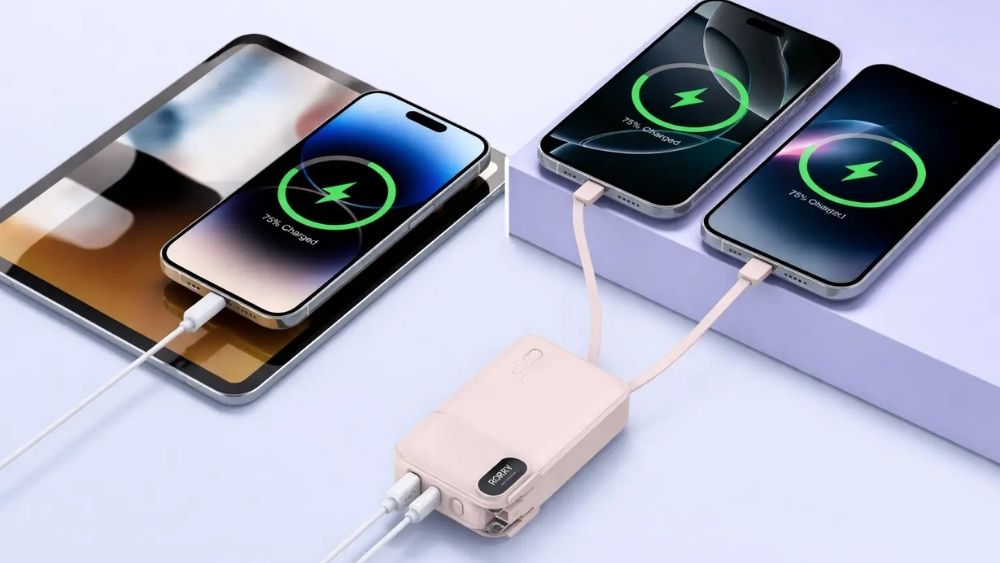
- par kehuiyi
What Does mAh Mean on a Battery/Power Bank? Complete 2026 Guide
- par kehuiyi
When you’re shopping for a power bank, smartphone, or wireless earbuds, you’ll almost always see “mAh” listed in the specs. Many people see the number but aren’t sure what it really means or how important it is. This guide explains mAh in simple, practical terms so you can make smarter choices in 2026.
mAh stands for milliampere-hour. It is a unit that measures the storage capacity of a battery — basically, how much electric charge it can hold.
Think of it like the size of a fuel tank in a car. A higher mAh number means the battery can store more electricity and potentially provide more power or more charges to your devices. For example, a 10,000mAh power bank can theoretically supply 10,000 milliamperes of current for one hour, or 5,000mA for two hours.
However, mAh is only a theoretical capacity. It doesn’t directly tell you how many hours your phone will last, because actual usage depends on how much power the device is consuming at any moment.

While mAh tells you the charge capacity, Wh (Watt-hour) is a more accurate way to measure the actual energy stored in a battery or power bank.
Wh takes both capacity (mAh) and voltage into account, giving you a better idea of real energy content. You can roughly calculate it with this formula:
Wh = mAh × Voltage ÷ 1000
For example, a 10,000mAh power bank at 3.7V is about 37Wh. This number is especially important when flying, as most airlines limit power banks to 100Wh. Therefore, it is important to choose a suitable power bank before traveling or flying.
Wireless Earbuds: 40mAh – 60mAh (per earbud), 400mAh – 600mAh (charging case). Since earbuds are extremely small, they rely on their charging case to provide multiple recharges throughout the day.
Smartwatches: 300mAh – 800mAh. Space is limited in wearables, so they use small batteries that are highly optimized for health tracking and notifications.
Smartphones: 4,000mAh – 5,500mAh. This is the standard range for modern phones, designed to support high-performance chips for a full day of mixed use.
Tablets: 7,000mAh – 11,000mAh. Larger screens require much more power, necessitating these high-capacity cells for long hours of video or productivity.
Laptops: 4,00mAh – 10,000mAh. Laptops require massive amounts of energy to run powerful processors and large displays for several hours.
Power Banks: 5,000mAh – 30,000mAh. As a backup power source, the higher the mAh, the more times it can fully recharge your other devices on the go.
While larger mAh ratings generally mean more power, actual battery life depends on chip efficiency and software. For a detailed look at how these numbers translate to real-world phone use, check our guide: How Long Does iPhone Battery Last? Real Reviews.

In everyday use, mAh helps you estimate how many times a power bank can charge your phone. Here’s a practical comparison for 2026 flagship devices:
|
Power Bank Capacity |
Full Charges (iPhone 17 / Galaxy S26) |
Best For |
|
5,000 mAh |
1 – 1.3 times |
Emergency top-ups |
|
10,000 mAh |
2.3 – 2.8 times |
Daily commute |
|
20,000 mAh |
4.5 – 5.5 times |
Travel & long flights |
|
30,000 mAh |
7+ times |
Heavy users, outdoor |
Important note: Real results are usually 70–85% of the rated mAh because of energy loss from heat, voltage conversion, and circuit efficiency.
A larger mAh rating generally allows for longer screen-on time, but brands like RORRY portable charge also use more efficient chips and better power management, allowing for good battery life even with relatively smaller mAh capacities.
A bigger mAh number sounds better, but it doesn’t guarantee better performance. Several other factors play a big role:
Efficiency Loss: Most power banks only deliver 70–85% of their labeled capacity in actual use.
Charging Speed: A 10,000mAh power bank that supports 65W fast charging is much more useful than a 20,000mAh one with only basic 5W output.
Size and Weight: Higher capacity usually means a larger and heavier power bank.
Voltage and Protocols: Support for PD, PPS, or other fast-charging standards greatly affects real charging time and compatibility.
This explains why two power banks with the same mAh can feel very different in daily use.
For most people, a 10,000mAh power bank offers the best balance of capacity and portability. It’s compact enough for everyday carry and can recharge a modern phone 2–3 times.
Frequent travelers or people on long flights usually prefer a 20,000mAh power bank. Heavy users who stream videos, play games, or rely on GPS all day should consider 25,000mAh or higher models.
Always check the power bank capacity allowed on planes. Most airlines limit power banks to 100Wh.

Don’t just chase the highest mAh number. Here’s what you should focus on:
Choose reputable brands like Anker or RORRY that offer good efficiency and clear specifications.
Prioritize fast charging support (at least 30W, preferably 65W+).
Look for essential safety features: over-current, over-voltage, and temperature protection.
Store unused power banks at 30–60% charge in a cool place.
Recharge them every 2–3 months to maintain battery health.
Use high-quality cables and avoid extreme temperatures during charging.
These simple habits will help you get better real-world performance and extend the lifespan of your power bank.
mAh is simply a measurement of how much charge a battery or power bank can store. While a higher number means greater potential capacity, real performance depends on efficiency, charging speed, heat management, and build quality.
Now that you understand mAh, you can make better decisions and avoid being misled by big numbers alone. Focus on balanced capacity, fast charging support, and reliable brands to get the best value and longest-lasting performance from your power banks in 2026 and beyond.
Not always. While it means more capacity, you must also consider charging speed and size. A fast-charging 10,000mAh model is often more practical for daily use than a bulky, slow 20,000mAh one.
Efficiency loss is the reason. Energy is lost as heat during voltage conversion. You typically get 70–85% of the rated capacity, enough for about 1.5 full charges on a modern flagship.
Yes. Most airlines limit them to 100Wh (about 27,000mAh). They must be in your carry-on bag, never in checked luggage, to meet strict aviation safety regulations.
Yes. Many chargers, like those from RORRY, feature dedicated magnetic modules for Apple Watch and low-current modes to safely power small wearables without auto-shutting off.
Trust established brands. If a tiny, cheap power bank claims 50,000mAh, it’s likely a fake rating. Reputable names provide transparent specs and use high-grade, safe lithium cells.


Partager:
How Long Do AirPods Take to Charge? The Complete 2026 Model Guide
How to Charge Your Phone Faster? 6 Tips That Actually Work