


- by kehuiyi
Do you really need a 20,000mAh power bank? Who is it for?
- by kehuiyi
A 20,000mAh power bank can charge most smartphones four to six times before needing a refill. It handles tablets, laptops, and multiple devices at once — and it is allowed on most flights without prior approval.
It is not the right size for everyone though. It is heavier and slower to recharge than smaller options, and for daily commuters, it is often more than necessary. This guide covers who benefits from one, what the trade-offs look like, and what to check before buying.
Power banks lose some energy during the charging process — typically around 25–30% — due to voltage conversion and heat. So a 20,000mAh bank delivers closer to 14,000–15,000mAh of usable capacity in practice. Here is what that looks like across common devices:
|
Device |
Approx. Charges |
|
Smartphone (4,000–5,000mAh) |
3–5 full charges |
|
Tablet (7,000–10,000mAh) |
1–2 full charges |
|
Laptop (ultrabook, 45–65Wh) |
0.5–1 full charge (PD required) |
|
Wireless earbuds (~50mAh case) |
40–60+ charges |
|
Smartwatch (~300mAh) |
30–40 charges |
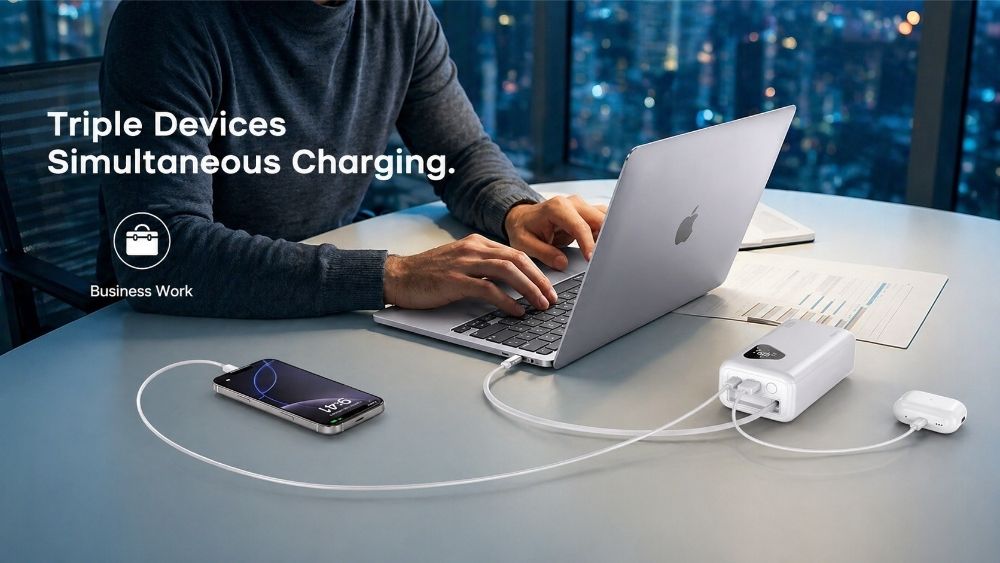
Laptops require a specific mention. A 20,000mAh power bank can charge most ultrabooks, but only if it supports USB-C Power Delivery at 45W or above. Standard USB-A output does not deliver enough wattage to charge a laptop effectively, so it is worth checking the output spec before assuming compatibility.

Whether 20,000mAh makes sense comes down to how long you are typically away from a wall outlet, and how many devices you need to keep running in that time.
Long-haul flights, layovers, and multi-day trips are where a high-capacity bank earns its place. When you are away from an outlet for 8 hours or more and relying on your phone for boarding passes, navigation, and maps, a 20,000mAh power bank covers the full journey without needing to manage battery carefully.
When there are no outlets for days at a time, a high-capacity bank becomes the central charging hub for phones, headlamps, GPS devices, and cameras. In this context, capacity matters more than portability.
Photographers, videographers, and anyone whose work requires devices to stay alive through long shoots or field sessions. Charging multiple devices simultaneously is where 20,000mAh goes from convenient to necessary.
If you regularly carry a phone, tablet, earbuds, and a smartwatch and want a single bank to cover all of them through a full day or longer, 20,000mAh is the right capacity tier.
For daily routines that involve a commute, an office, and regular access to wall outlets, a rorry portable charger covers most needs at roughly half the weight. The extra capacity of a 20,000mAh bank goes largely unused in this scenario.
Pros
Charges most smartphones 3–5 times on a single fill
Covers tablets and ultrabooks with PD support
One bank for multiple devices — phone, earbuds, watch, and more
Well-suited for multi-day trips without outlet access
Reduces reliance on finding a plug in airports, cafes, or transit
Cons
Heavier and bulkier than smaller options — most 20,000mAh banks weigh 350–450g
Takes considerably longer to recharge itself
Higher price point than 10,000mAh equivalents
More capacity than most daily commuters will realistically use

Yes, in most cases. A 20,000mAh power bank typically falls around 74Wh based on a 3.7V nominal voltage, which sits comfortably under the standard airline limit of 100Wh for carry-on batteries that require no prior approval.
A few rules apply across airlines regardless of capacity:
Power banks must go in carry-on luggage only — never checked baggage
Banks between 100Wh and 160Wh require airline approval in advance
Banks over 160Wh are prohibited on passenger aircraft
Regulations can vary by airline and are updated periodically, so it is worth checking the current power bank capacity allowed on planes rules before you travel — especially on international routes where carriers sometimes apply stricter limits than the standard.
Recharge time depends on the wall adapter you plug into — not the power bank's output wattage. A power bank also has a maximum input it can accept, so pairing a fast adapter with a bank that only supports 18W input will not speed things up beyond that ceiling.
|
Wall Adapter Output |
Approx. Recharge Time |
|
Standard 5W USB-A |
10–15 hours |
|
18W USB-C PD |
6–8 hours |
|
30W USB-C PD |
3–4 hours |
|
45W+ USB-C PD |
2–3 hours |
Check the maximum input wattage on the power bank's spec sheet before buying. A 30W power bank or above input refills in a fraction of the time compared to one limited to 18W — a meaningful difference when you need it topped up before leaving in the morning.

Capacity is just one part of the spec sheet. These are the factors that affect day-to-day performance.
For smartphones, 20W USB-C PD is the minimum for fast charging. For laptops, look for 45W or above. A bank with only USB-A output is capped at around 12W — fine for phones, but not sufficient for laptops.
Input wattage determines how long it takes to refill the bank. Models with at least 30W PD input are worth prioritising at this capacity — 65W input brings recharge time down to a practical range for daily use.
At a minimum, look for one USB-C and one USB-A port. Two USB-C ports with independent PD support allow a phone and a laptop to charge simultaneously without either port throttling the other.
Most 20,000mAh banks fall between 350g and 500g. There is meaningful variation between models at the same capacity, so checking the weight spec is useful if portability is a priority. Slim designs exist at this capacity but often trade off port count or input speed.
CE, FCC, or UL certification indicates the bank has passed independent electrical safety testing. Banks without certification — particularly at lower price points — can deliver inconsistent wattage output, which may slow charging or trigger a device's protection circuits. Established brands like RORRY list certifications clearly on their product pages, which makes it straightforward to verify before buying.
A 20,000mAh power bank makes sense for frequent travelers, outdoor users, content creators, and anyone managing multiple devices away from an outlet. For everyday use with regular access to charging points, a smaller bank is usually the more practical choice.
Yes, in carry-on luggage only. Most 20,000mAh banks sit around 74Wh, under the standard 100Wh carry-on limit. Power banks should never be packed in checked baggage.
Around 3–5 times, depending on the model. Due to energy loss during transfer, usable capacity is closer to 14,000–15,000mAh. An iPhone 15 Pro gets approximately 4–5 charges; an iPhone 15 Plus gets around 3–4.
Yes, provided it supports USB-C Power Delivery at 45W or above. Standard USB-A output is not sufficient for laptop charging. Check both the power bank's output wattage and your laptop's minimum charging requirement before purchasing.
For most people with regular access to wall outlets, a 10,000mAh bank is lighter and handles daily needs without the extra bulk. The 20,000mAh capacity is better suited for travel, outdoor trips, or extended periods away from charging points.


Share:
Which Samsung Phones Have Wireless Charging in 2026?
USB-C vs Lightning: Which Charges Better and Faster?